

Table of Contents
- What Is CM3 Certification and Who Uses It?
- What Does CM3 Actually Verify?
- How CM3 Certification Makes Compliance Easier for Your Organisation
- CM3 Certified vs Non-Certified: What Is the Real Difference?
- What Types of Projects and Organisations Benefit Most?
- How WSG Group Maintains Its CM3 Certification
- Frequently Asked Questions
Choosing a CM3 certified contractor gives your organisation independently verified proof that a trade business has the WHS systems, insurance, and licences required to work safely and compliantly. For commercial clients, strata managers, facility operators, and government procurement teams across Sydney and NSW, that distinction matters more than a handshake and a quote.
This guide explains what CM3 certification means in practice, why it streamlines contractor onboarding, and how working with a CM3 prequalified trade business protects your organisation from compliance exposure.
What Is CM3 Certification and Who Uses It?
CM3 is an independent contractor management and prequalification platform widely used across Australia by large commercial clients, government agencies, facility managers, and strata operators. When a contractor earns CM3 prequalification, it means a qualified WHS professional has independently assessed and verified that the business meets defined standards across three critical areas: workplace health and safety systems, trade licences, and insurance coverage.
The platform is owned by Blackwoods (part of the Wesfarmers Group) and is recognised by some of Australia’s largest organisations as a trusted contractor compliance gateway. Many commercial and government clients in NSW now list CM3 prequalification as a mandatory requirement before a contractor can be considered for work — making it a genuine differentiator for trade businesses that hold it.
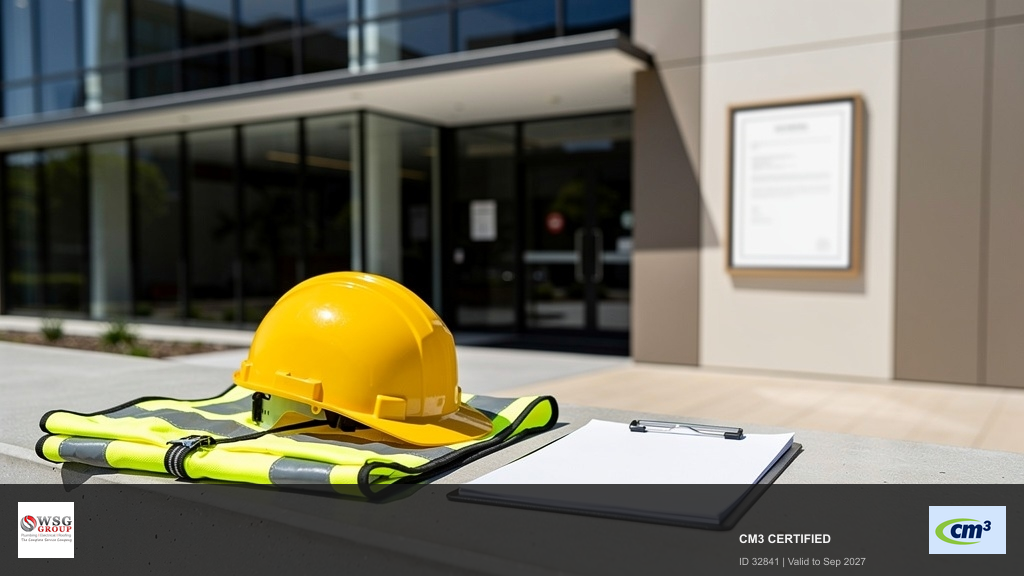
WSG Group holds active CM3 prequalification under Cm3 ID 32841, with certification valid through September 2027. This was independently assessed and covers WHS system documentation, organisation trade licences, electrical work (employee low voltage), work with fall risks including portable ladders, and verified insurance coverage including $20 million public liability and $5 million professional indemnity.
What Does CM3 Actually Verify?
Unlike a self-declared accreditation, CM3 prequalification is assessed by qualified WHS professionals — not just ticked off by the contractor themselves. The assessment covers a defined scope of demonstrated capabilities that must be evidenced and maintained for the certificate to remain valid.
For WSG Group’s current certification, the verified scope includes:
| Verified Area | What It Confirms |
|---|---|
| WHS System Documentation | Active, documented workplace health and safety management systems are in place |
| Organisation Trade Licences | The business holds valid trade licences relevant to the work being performed |
| Electrical Work (Low Voltage) | Licenced to perform low voltage electrical work through employed electricians |
| Work at Height / Fall Risks | Policies and safety equipment in place for ladder work and other fall-risk activities |
| Public Liability Insurance | $20,000,000 cover — verified and current |
| Workers Compensation (NSW) | Active NSW workers compensation policy covering all employees |
| Professional Indemnity | $5,000,000 cover — verified and current |
This breadth of verified coverage is what separates CM3 prequalification from a standard certificate of currency. The insurance documents, licences, and WHS systems have been checked by an independent party — not just stated by the contractor.
How CM3 Certification Makes Compliance Easier for Your Organisation
The real value of selecting a CM3 certified contractor is not just about the contractor — it is about what it removes from your procurement and compliance workflow. Here is how it translates into practical benefits for commercial clients, facility managers, and project teams.
Reduced Onboarding Time
Bringing a new contractor on board typically involves collecting and verifying insurance certificates, checking licence numbers, reviewing WHS documentation, and confirming workers compensation coverage. For a non-prequalified contractor, this can take days of back-and-forth. With a CM3 certified contractor, that verification has already been completed by an independent assessor. Many organisations that use CM3 as their compliance gateway can confirm a contractor’s status within minutes through the CM3 platform, rather than conducting their own audit from scratch.
Independent Verification You Can Rely On
Self-certified safety records and self-provided insurance documents carry inherent risk — they rely on the contractor being accurate and current. CM3 prequalification removes that reliance. The assessment is conducted by qualified WHS professionals with no commercial interest in the outcome. For organisations operating under chain of responsibility obligations, working with a CM3 certified contractor provides an additional layer of documented due diligence.
Suitable for High-Risk and Regulated Environments
Government facilities, strata buildings, commercial properties, aged care sites, and educational institutions all operate under strict WHS and contractor management obligations under the NSW Work Health and Safety Act 2011. Selecting a CM3 prequalified contractor demonstrates that your procurement process has gone beyond minimum standards — an important consideration in environments where compliance audits are routine.
Stronger Confidence in Tenders and Proposals
Many NSW government and large commercial tender documents now specifically request or reward CM3 prequalification as evidence of contractor compliance maturity. Working with a CM3 certified trade business means the compliance documentation is already in order, reducing friction during the tender evaluation process and increasing confidence for procurement panels reviewing competing submissions.
CM3 Certified vs Non-Certified: What Is the Real Difference?
Across Sydney’s commercial trade market, the majority of trade businesses are not CM3 prequalified. That does not mean they are unsafe or unlicensed — but it does mean your organisation carries the burden of verifying their credentials independently before every engagement. Here is a direct comparison.
| Consideration | CM3 Certified Contractor | Non-Certified Contractor |
|---|---|---|
| WHS system verification | Independently assessed by qualified WHS professional | Self-declared or unverified |
| Insurance verification | Independently collected and tracked by CM3 | Client must verify directly each engagement |
| Trade licence check | Confirmed during assessment | Client responsibility to verify |
| Ongoing currency | CM3 tracks renewal and alerts on expiry | Manual follow-up required |
| Procurement time | Streamlined — compliance status pre-verified | Longer — full in-house verification needed |
| Tender suitability | Recognised in NSW government and large commercial tenders | May not meet minimum requirements |
| Chain of responsibility | Documented independent due diligence | Client holds greater compliance burden |
For organisations that manage multiple contractors or regularly engage trade services across several sites, the cumulative compliance burden of working with non-prequalified contractors is significant. CM3 prequalification systematises that burden at the contractor level.
What Types of Projects and Organisations Benefit Most from CM3 Certified Contractors?
CM3 prequalification is most valuable where contractor compliance obligations are highest. In practical terms, that includes:
- Commercial and industrial property owners managing ongoing maintenance across multiple tenancies or sites in Sydney and Greater NSW
- Strata managers with legislative obligations under the Strata Schemes Management Act 2015 to maintain common property safely and engage compliant contractors
- Government and council facilities teams in NSW where tender requirements routinely specify contractor prequalification
- Facility management companies operating aged care, healthcare, or educational sites under strict regulatory frameworks
- Property developers in the defects liability phase needing documented contractor compliance for building handover records
- Construction principal contractors managing subcontractor compliance under NSW WHS regulations and AS/NZS standards
For smaller residential jobs — a tap repair, a blown circuit breaker, a leaking roof — CM3 certification is less of a deciding factor. But for anything involving commercial property, government assets, shared facilities, or high-risk works, it becomes a meaningful signal of contractor maturity.
How WSG Group Maintains and Uses Its CM3 Certification
WSG Group’s CM3 prequalification is not a one-time exercise. Certification requires ongoing maintenance — insurance policies must be renewed and re-verified, WHS systems must remain current, and the certification itself undergoes periodic review. WSG Group’s current certificate was issued in July 2026 and is valid through September 2027, covering the trade areas that make up the core of WSG’s commercial service offering: electrical work, height and fall-risk activities, and general WHS compliance across plumbing, roofing, and drainage works.
In practical terms, this means clients who engage WSG Group for commercial electrical, plumbing, roofing, or maintenance work can request the CM3 certificate number (32841) and verify active status independently through the CM3 platform. This is a level of transparency that non-prequalified trade businesses simply cannot offer.
WSG Group is also a member of the Master Plumbers Association and the National Electrical and Communications Association (NECA), providing additional professional accountability alongside the CM3 WHS verification layer. These affiliations, combined with CM3 prequalification, create a compliance profile that is well-suited to commercial procurement requirements across Sydney and the Central Coast.
Working With a CM3 Certified Contractor Has Never Been Simpler
WSG Group’s CM3 prequalification means your compliance documentation is already done. Get in touch to discuss your next commercial, strata, or facility maintenance project across Sydney and NSW.
Get Your Free QuoteFrequently Asked Questions About CM3 Certified Contractors
What does it mean when a contractor is CM3 certified?
A CM3 certified contractor has been independently assessed by qualified WHS professionals and confirmed to meet defined standards for workplace health and safety systems, trade licences, and insurance coverage. It is an independent third-party verification — not a self-declared certificate.
Is CM3 prequalification mandatory for NSW government work?
CM3 prequalification is not universally mandated, but many NSW government departments, councils, and government-owned corporations include it as a requirement or weighted criterion in tender and contractor panel processes. Checking specific procurement requirements with the relevant agency before bidding is always advisable.
How long does CM3 certification last?
CM3 certification is subject to ongoing maintenance and periodic review. Insurance and licence documentation must be kept current within the CM3 system, and assessments are renewed on a defined schedule. WSG Group’s current certification was issued July 2026 and runs through September 2027, subject to maintained documentation currency.
Can I verify a contractor’s CM3 status before engaging them?
Yes. Organisations that are registered CM3 clients can search and verify contractor prequalification status directly through the CM3 platform. If you are not a CM3 client, you can request that the contractor provide their CM3 ID and certificate — WSG Group’s CM3 ID is 32841.
Does CM3 certification cover subcontractors?
CM3 prequalification covers the contractor entity that holds the certificate — in this case WSG Group Pty Ltd. If a principal contractor requires subcontractors to also be CM3 prequalified, each subcontracting business needs its own certification. WSG Group’s certification applies to work performed by WSG Group directly.
What industries and project types is CM3 used in across NSW?
CM3 is used across a broad range of industries in NSW including commercial and industrial property, government and council, aged care and healthcare, education, strata management, retail and hospitality, and construction. Any sector with structured contractor management obligations tends to use platforms like CM3 to reduce their compliance burden.
Is CM3 the same as an ISO safety certification?
No. CM3 prequalification is specifically focused on contractor WHS management, insurance, and licences for the purposes of engaging contractors safely. ISO 45001 (occupational health and safety management systems) is a broader international standard for an organisation’s internal WHS management system. They serve different purposes and are not interchangeable, though some organisations hold both.