

How Much Does a New Hot Water System Cost on the Central Coast?
Hot water system replacement cost on the Central Coast typically ranges from $900 to $4,500 installed, depending on the system type, size, and your existing setup. A standard electric storage tank replacement in a Gosford or Wyong home usually falls between $1,200 and $1,800 all in. Gas, solar, and heat pump systems sit higher — but NSW rebates can reduce that gap significantly.
Whether your old system has given up or you are planning ahead, this guide walks through every system type, what drives the price, what rebates apply in NSW, and how to get a fair quote from a licensed plumber on the Central Coast.
Table of Contents
- Hot Water System Types and Costs
- What Affects the Price of Replacement?
- Should You Repair or Replace?
- NSW Government Rebates Available on the Central Coast
- How to Choose the Right System for a Central Coast Home
- Getting a Fair Quote from a Central Coast Plumber
- Frequently Asked Questions
Hot Water System Types and Costs on the Central Coast
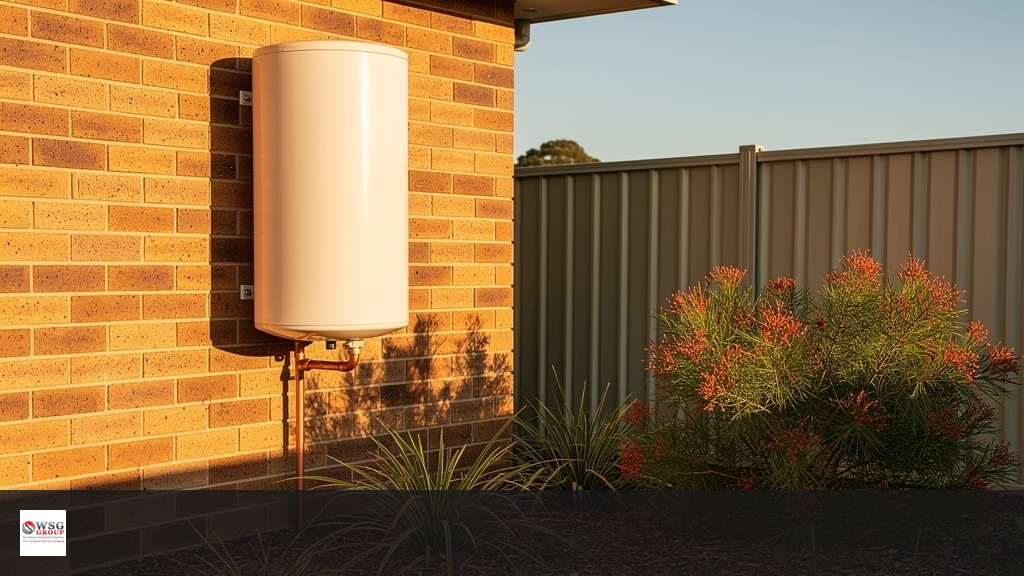
The most common hot water system in Australian homes is still the traditional electric storage tank — a white cylindrical unit, usually mounted on an external wall. It is the baseline most Central Coast households start from, and the cheapest to replace on a like-for-like basis. Gas storage and instantaneous systems are popular where mains gas is connected. Heat pump and solar hot water systems attract strong NSW rebates but come with higher upfront costs.
| System Type | Typical Installed Cost (AUD) | Notes |
|---|---|---|
| Electric storage tank (50–315L) | $900 – $1,800 | Most common replacement; like-for-like is fastest and cheapest |
| Gas storage (90–360L) | $1,200 – $2,400 | Requires mains gas or LPG; good running cost efficiency |
| Gas continuous flow (instantaneous) | $1,400 – $2,600 | No tank; heats on demand; popular for larger homes |
| Heat pump hot water system | $2,800 – $4,500 | Eligible for NSW PDRS/ESS rebates; can reduce running costs by up to 75% |
| Solar hot water (evacuated tube/flat plate) | $3,000 – $5,000 | Eligible for STCs (federal); suits Central Coast’s high solar exposure |
All prices above include supply of the unit and standard installation by a licensed plumber. They assume a straightforward swap-out with no major changes to pipework or electrical connections. Complex jobs — such as switching from electric to gas, or adding a new gas line — will add to the final cost.
Electric Storage Tanks — The Common Starting Point
Most Central Coast homes in suburbs like Gosford, Wyong, Erina, and Woy Woy run electric storage tanks. They are simple, reliable, and parts are always available. A 250L unit — the right size for a household of 3–4 — typically costs $1,100 to $1,600 installed. The main downside is running cost: electric resistance heating is the most expensive to operate of all system types.
If you are replacing a failed electric tank on a like-for-like basis, a licensed plumber can usually complete the job in two to three hours. If the tank is in an accessible external location, costs tend to sit toward the lower end of the range.
Gas Hot Water Systems
Gas storage and continuous flow systems are popular across the Central Coast where mains gas is connected. Areas including parts of Gosford and Terrigal have reticulated gas. If you are on LPG (bottled gas), running costs are higher — factor this in when comparing options.
A gas continuous flow system is particularly suited to larger households or properties with high simultaneous demand. It heats water only when a tap is opened, which avoids the standby heat losses associated with storage tanks. Installation is more involved — the flue position and gas supply capacity need to be checked — which is reflected in the slightly higher installed price.
Heat Pump Hot Water Systems
A heat pump works like a reverse air conditioner — it extracts heat from the surrounding air and uses it to heat water rather than generating heat directly. The Central Coast climate, with mild winters and warm summers, is well-suited to heat pump operation. The technology is most efficient when ambient air temperatures are above 10°C, which covers the vast majority of the year on the Coast.
The upfront cost is higher than a storage tank, but heat pumps use roughly 60–75% less electricity to produce the same amount of hot water. Combined with NSW rebates (see the section below), the payback period for many Central Coast households is three to five years.
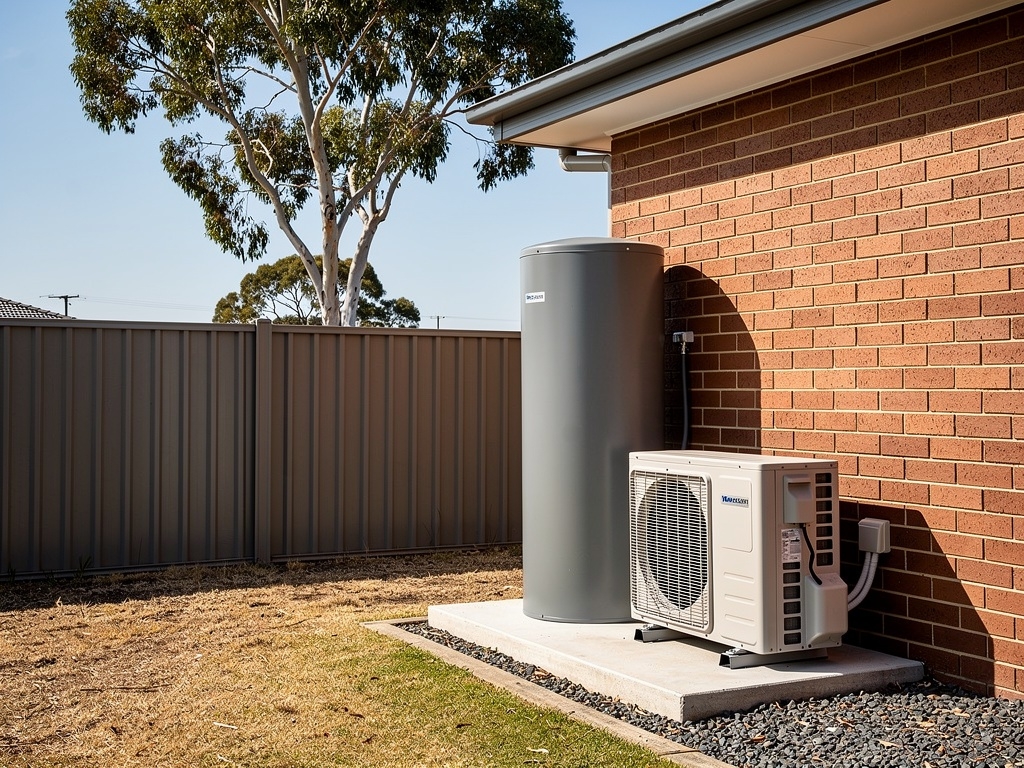
A standard residential heat pump unit consists of a compressor/fan unit and a storage cylinder — this is the normal Australian configuration. When getting quotes, confirm the storage capacity is appropriate for your household size (200–315L for a family of 3–5).
What Affects the Price of a Hot Water Replacement?
The price of hot water system replacement on the Central Coast varies based on several factors beyond just the unit itself. Understanding these helps you evaluate quotes more accurately and avoid unexpected extras.
Like-for-Like vs System Change
Replacing an electric tank with another electric tank is the simplest and cheapest scenario. The plumber disconnects the old unit, positions the new one in the same location, reconnects the pipework and electrical supply, and commissions the system. Total time: typically two to three hours.
Switching from electric to gas requires a gas line connection, gas compliance work, and often an electrician as well. This can add $500 to $1,500 to the project depending on the distance from the gas meter to the installation point. Similarly, adding solar panels to a roof or relocating a unit to a better position adds labour and materials.
Tank Size and Location
Larger tanks cost more to supply and are slightly heavier to handle. A 400L commercial-grade unit costs significantly more to install than a domestic 125L unit. Location matters too — a tank in a tight indoor cupboard or requiring roof access takes longer to replace than one on an easily-accessible external wall.
Pipework Condition and Valves
Older homes in Central Coast suburbs like The Entrance, Ettalong Beach, and Woy Woy sometimes have original copper pipework that shows corrosion or scaling near the hot water connection points. If the tempering valve, pressure relief valve, or isolation valves need replacement (required by AS/NZS 3500.4 for new installations), that adds $100–$300 to the job. A good plumber will identify this during the quote, not after the work starts.
After-Hours and Emergency Callouts
If your system has failed and you need same-day replacement outside business hours, expect a higher callout rate. Most licensed plumbers on the Central Coast charge $60–$100 for standard-hours callouts and $150–$300 for after-hours emergency attendance. These are market benchmarks — always confirm the callout fee before booking. The replacement unit cost and installation labour are charged on top of the callout fee.
Service fees vary between providers. Always confirm the callout fee before booking.
Should You Repair or Replace Your Hot Water System?
The answer depends mainly on the age of your system and the nature of the fault. As a general rule: if the system is more than 10 years old and the repair cost exceeds $400, replacement usually makes better financial sense than repair.
Repair is Usually Worth It When:
- The system is less than 8 years old
- The fault is a single component — thermostat, heating element, or sacrificial anode
- The repair cost is under $300–$400
- The tank itself is structurally sound with no signs of rust or external corrosion
Replacement Makes More Sense When:
- The system is 10 or more years old
- The tank is leaking from the body (not a valve — this cannot be repaired)
- You have had repeated faults or callouts in the past two years
- The repair quote is close to or above $600
- You want to switch to a more efficient system and access NSW rebates
Most electric storage hot water systems have a lifespan of 10–15 years. Gas systems typically last 12–20 years. If your system is approaching or past these ages, factor in the likelihood of further repairs when weighing up the decision.
Not sure whether to repair or replace? See our guide on when to repair vs replace your home systems for a framework that applies across trades.
NSW Government Rebates Available on the Central Coast
Central Coast residents upgrading from an electric resistance hot water system to a heat pump or solar system are eligible for significant NSW Government financial incentives. These rebates are administered under the NSW Energy Savings Scheme (ESS) and Peak Demand Reduction Scheme (PDRS), and can reduce the upfront cost by $300 to $1,000 depending on the system and your circumstances.
NSW PDRS and ESS Rebates — Heat Pump Hot Water
Under the PDRS and ESS, installing a qualifying heat pump hot water system in a home currently running an electric resistance storage tank generates energy savings certificates (ESCs and PRCs). These are purchased by energy retailers and reduce the cost you pay for the system. In practical terms, this appears as a point-of-sale discount when you purchase through a licensed installer who is registered to create certificates.
The discount varies depending on the size of the system and current certificate prices, but typically ranges from $300 to $1,000 off the installed price of a heat pump. Your plumber should be able to tell you whether the system they are quoting is eligible and what the expected rebate will be.
For up-to-date information on current rebate values, see the NSW Energy rebates and schemes page.
Federal STCs — Solar Hot Water
Solar hot water systems are eligible for Small-scale Technology Certificates (STCs) under the federal Renewable Energy Target. The number of STCs depends on the system’s rated output and the climate zone. The Central Coast falls within a high-solar zone (Zone 3), making STCs particularly valuable here. The STC discount is typically applied at point of sale by the installer — expect a reduction of $700 to $1,500 on a quality solar hot water system.
| Rebate / Scheme | System Type | Typical Saving (AUD) | Applied By |
|---|---|---|---|
| NSW ESS / PDRS | Heat pump hot water | $300 – $1,000 | Registered installer (point-of-sale) |
| Federal STCs | Solar hot water | $700 – $1,500 | Registered installer (point-of-sale) |
| Federal STCs | Heat pump hot water | $300 – $600 | Registered installer (point-of-sale) |
How to Choose the Right System for a Central Coast Home
Choosing the right hot water system for your Central Coast home depends on your existing energy connection, household size, budget, and how long you plan to stay in the property. Here is a practical framework for making the decision.
Do You Have Mains Gas?
If your home is connected to the reticulated gas network (common in parts of Gosford and Terrigal), a gas continuous flow or gas storage system offers a good balance of performance and running cost. Gas instantaneous systems are particularly well-suited to larger households in areas like Erina and Kincumber where multiple bathrooms or high simultaneous use is common.
If you are on LPG, the running cost advantage of gas narrows considerably. In that situation, a heat pump is often a better long-term choice — especially with NSW rebates reducing the upfront cost.
What Is Your Household Size?
| Household Size | Recommended Tank Size | Suitable Systems |
|---|---|---|
| 1–2 people | 80–125L | Electric storage, gas storage, gas continuous flow |
| 3–4 people | 160–250L | Electric storage, gas storage, heat pump (200–270L), gas continuous flow |
| 5+ people | 315–400L | Gas storage, gas continuous flow, heat pump (315L+), solar |
Central Coast Climate and Heat Pump Performance
The Central Coast’s temperate coastal climate is genuinely well-suited to heat pump hot water systems. Unlike inland NSW locations that experience hard frosts in winter, the Gosford–Wyong corridor rarely sees temperatures drop below 5–7°C, and most of the year sits comfortably in the 15–28°C range. Heat pumps operate most efficiently at temperatures above 10°C, so performance on the Coast is strong year-round compared to alpine or tablelands locations.
Position the heat pump unit where it has good airflow — not enclosed in a small cabinet. External walls with access to ambient air are ideal. Units should also be placed where noise from the fan will not disturb bedrooms, as heat pumps produce a low hum during operation similar to a split-system air conditioner.
Still deciding between solar and heat pump? Read our in-depth comparison: solar hot water vs heat pump systems.
Getting a Fair Quote from a Central Coast Plumber
A well-prepared quote from a licensed Central Coast plumber should itemise the unit cost, labour, any additional materials (valves, straps, pipe fittings), and any applicable rebates. If a quote is presented as a single lump sum with no breakdown, ask for an itemised version before agreeing.
What to Ask Before You Approve the Job
- Is the system on the approved product list for NSW ESS/PDRS rebates?
- Is the rebate already applied to the quoted price, or is it handled separately?
- What is the warranty on the unit and on the labour?
- Will the old unit be removed and disposed of, and is that included in the price?
- Is the installation compliant with AS/NZS 3500.4 including tempering valve and pressure relief valve requirements?
- Is the plumber licensed in NSW? (Check via NSW Fair Trading)
If you are a landlord or property manager, see our guide on landlord hot water system obligations in NSW.
Need a Hot Water System Quote on the Central Coast?
WSG Group services Gosford, Wyong, Erina, Terrigal, The Entrance, Woy Woy, and surrounding areas. Licensed plumbers, upfront pricing, same-day emergency response.
Get a Free QuoteFrequently Asked Questions
How much does a hot water system replacement cost on the Central Coast?
Hot water system replacement on the Central Coast typically costs between $900 and $4,500 installed, depending on the system type. A standard electric storage tank replacement is usually $900–$1,800. Gas systems range from $1,200–$2,600, and heat pump systems cost $2,800–$4,500 before any NSW rebates are applied.
How long does a hot water system last in NSW?
Electric storage tanks typically last 10–15 years in NSW conditions. Gas storage and continuous flow systems generally last 12–20 years. Heat pump and solar systems have comparable lifespans of 10–20 years depending on maintenance. Coastal locations like the Central Coast can shorten tank lifespans slightly due to salt-laden air affecting external components.
What NSW rebates are available for hot water systems on the Central Coast?
Central Coast homeowners upgrading from an electric resistance hot water system to a heat pump are eligible for NSW ESS and PDRS rebates, typically worth $300–$1,000 off the installed price. Solar hot water systems are eligible for federal Small-scale Technology Certificates (STCs), worth approximately $700–$1,500 depending on system size.
How quickly can a failed hot water system be replaced on the Central Coast?
Most like-for-like hot water system replacements on the Central Coast can be completed the same day or next day. WSG Group offers 24/7 emergency response across Gosford, Wyong, and surrounding suburbs. After-hours callouts are available for urgent failures.
Is a heat pump hot water system suitable for the Central Coast climate?
Yes. The Central Coast’s mild coastal climate — with temperatures rarely below 7°C even in winter — is well-suited to heat pump operation. Heat pumps work most efficiently above 10°C, and the Gosford–Wyong area meets this threshold for most of the year. Combined with NSW rebates, heat pumps offer strong long-term value for Central Coast households.
Can I switch from electric to gas hot water on the Central Coast?
Yes, provided your property is connected to the mains gas network. Parts of Gosford and Terrigal have reticulated gas. Switching requires a gas line connection and compliance work, which typically adds $500–$1,500 to the project cost. A licensed plumber and gasfitter can assess your property’s gas supply capacity during the quote.
What should I do if my hot water system fails overnight or on a weekend on the Central Coast?
Call a licensed plumber offering 24/7 emergency service. In most cases, a temporary repair or immediate replacement can be arranged. WSG Group provides after-hours emergency hot water response across the Central Coast, including Gosford, Wyong, Erina, and Woy Woy.