

Home maintenance costs in Sydney can feel like a mystery. One homeowner pays $200 for a simple plumbing repair, while another receives a $1,500 quote for seemingly similar work. Are you being overcharged, or is there a genuine reason for the price difference?
Understanding typical home maintenance costs for plumbing, electrical, and roofing services empowers Sydney homeowners to budget confidently, avoid overpriced quotes, and recognize genuine value when they see it. Whether you’re a first-time homeowner planning your annual maintenance budget or an experienced property manager evaluating service quotes, transparent pricing information helps you make informed decisions.
In this comprehensive guide, we break down the actual costs you can expect for common and emergency services across Sydney and the Central Coast in 2026. From standard hourly rates and call-out fees to specific job pricing, you’ll discover what fair pricing looks like—and what factors influence costs in our region. Founded in 1947, WSG Group brings decades of pricing transparency to help you understand exactly what you’re paying for and why.
Understanding How Sydney Tradespeople Price Their Services
Before diving into specific costs, it’s essential to understand the pricing structures used by plumbers, electricians, and roofing professionals in Sydney. This knowledge helps you compare quotes accurately and understand what you’re actually paying for.
Most Sydney tradies use one of three pricing models—and quality professionals should be transparent about which they use before starting work.
Hourly Rate Pricing
Hourly rate pricing is the most common model for diagnostic work, repairs, and jobs where the scope isn’t immediately clear. The tradie charges a fixed rate per hour plus materials.
Typical Sydney Hourly Rates (2026):
- Plumbers: $90-$180 per hour
- Electricians: $90-$130 per hour
- Roof Plumbers/Roofers: $85-$150 per hour
These rates reflect the tradesperson’s expertise, licensing, insurance, vehicle costs, tools, and business overheads. Higher rates often indicate specialized expertise or premium service models with benefits like guaranteed response times.
What to Watch For: Always ask about minimum charge periods. Many tradies have a 1-hour or 2-hour minimum, meaning even a 20-minute job costs the full minimum period. This is standard practice and covers travel time and trip costs.
Fixed Price Quoting
For well-defined jobs, many professionals offer fixed-price quotes. You receive a total price covering all labor and materials before work begins—no surprises.
Fixed pricing works well for:
- Hot water system installations
- Switchboard upgrades
- Roof replacements
- Bathroom renovations
- Complete re-wiring projects
Advantages: Cost certainty, no risk of job running over time, easy comparison between quotes.
Considerations: Fixed quotes require thorough site inspection first. If conditions differ from what was quoted (hidden damage, non-compliant existing work), legitimate additional costs may apply.
Call-Out Fees Explained
Most Sydney tradies charge a call-out fee (also called service call fee or trip charge) covering:
- Travel to your property
- Vehicle and fuel costs
- Time spent diagnosing the issue
- Initial inspection and assessment
Standard Sydney Call-Out Fees (2026):
- Plumbers: $80-$200
- Electricians: $80-$150
- Roofers: $100-$250
The call-out fee is typically included in your final bill if you proceed with quoted work. If you decline the work, you still pay the call-out fee for the professional’s time and diagnosis.
Emergency & After-Hours Call-Outs: Expect fees to increase 50-100% for:
- After business hours (after 5pm weekdays)
- Weekends
- Public holidays
- Emergency/urgent calls
This premium reflects the tradie’s availability outside standard hours and the disruption to their personal time.
Plumbing Service Costs in Sydney 2026
Plumbing emergencies and routine maintenance are among the most common home service needs. Here’s what you can expect to pay for typical plumbing services across Sydney and the Central Coast.
Common Plumbing Repairs & Costs
| Service | Typical Cost Range |
| Dripping tap repair | $150 – $300 |
| Leaking toilet repair | $180 – $400 |
| Blocked drain (minor) | $200 – $450 |
| Blocked toilet | $180 – $350 |
| Hot water system service | $150 – $280 |
| Hot water system replacement (electric) | $1,200 – $2,800 |
| Hot water system replacement (gas) | $1,800 – $3,500 |
| Burst pipe emergency repair | $350 – $900 |
| Install new toilet | $400 – $750 |
| Install new kitchen tap | $250 – $450 |
| Bathroom renovation plumbing | $3,500 – $8,000 |
| Camera drain inspection | $250 – $500 |
Factors That Affect Plumbing Costs:
- Accessibility: Jobs requiring crawling under homes, working in tight roof spaces, or accessing buried pipes cost more due to difficulty and time required.
- Materials: Premium tapware, high-efficiency hot water systems, or imported fixtures increase material costs significantly beyond standard options.
- Urgency: Emergency plumbing (burst pipes, sewage overflows, no hot water) requires immediate response and commands premium pricing—typically 50-100% above standard rates.
- Complexity: Older homes with galvanized steel pipes, non-compliant existing work, or complications discovered during the job add labor time and cost.
- Property Type: Commercial properties, multi-story buildings, and strata complexes typically cost more due to compliance requirements and complexity.
Drainage & Gutter Services
- Professional Gutter Cleaning: $150-$350 for average single-story home, $250-$500 for two-story homes.
- CCTV Drain Inspection: $250-$500 for comprehensive camera inspection identifying blockages, cracks, or tree root intrusion.
- Drain Clearing (Hydro Jetting): $300-$800 depending on blockage severity and pipe length.
- Stormwater Drain Repairs: $500-$2,500 for pipe replacement or damaged drain repairs.
- Downpipe Installation: $150-$300 per downpipe including materials and labor.
Electrical Service Costs in Sydney 2026
Electrical work requires licensed professionals for safety and compliance with NSW regulations. Here’s what typical electrical services cost in Sydney.
Common Electrical Repairs & Installations
| Service | Typical Cost Range |
| Power point installation (single) | $120 – $220 |
| Light switch installation | $100 – $180 |
| Light fixture installation | $120 – $300 |
| Ceiling fan installation | $180 – $400 |
| Switchboard upgrade | $1,500 – $3,500 |
| Safety switch (RCD) installation | $180 – $350 |
| Smoke alarm installation (hardwired) | $150 – $280 per alarm |
| Rewiring single room | $800 – $1,800 |
| Complete house rewire (3 bedroom) | $8,000 – $15,000 |
| Air conditioning electrical connection | $250 – $600 |
| EV charger installation | $800 – $2,000 |
| Fault finding & diagnostics | $120 – $300 |
Factors That Affect Electrical Costs:
- Compliance Requirements: All electrical work must meet Australian Standards and NSW regulations. Older homes may need additional compliance work (like safety switch installation) before new work can proceed.
- Switchboard Capacity: If your switchboard is at capacity or outdated, upgrades may be necessary before adding new circuits—adding significant cost to otherwise simple jobs.
- Cabling Distance: Running cables long distances or through difficult paths (concrete walls, multi-story homes) increases labor time substantially.
- Quality of Fixtures: Budget light fittings cost $50-100, while designer fixtures can cost $500-2,000+ — material choice significantly impacts total cost.
- Emergency Response: After-hours electrical emergencies (no power, exposed wiring, burning smells) require immediate response with premium pricing 50-150% above standard rates.
Specialized Electrical Services
- Smoke Alarm Compliance (Interconnected System): $800-$1,500 for full home installation meeting current NSW standards.
- Data & Communication Cabling: $120-$250 per point for ethernet, phone, or TV antenna points.
- LED Downlight Conversion: $80-$150 per light for quality LED downlights including installation.
- Security Lighting Installation: $300-$800 for sensor lights with professional wiring.
- Pool Equipment Electrical Work: $400-$1,200 for pool pump wiring, lighting, and compliance certification.
- Electrical Safety Inspections: $250-$500 for comprehensive property electrical safety audit.
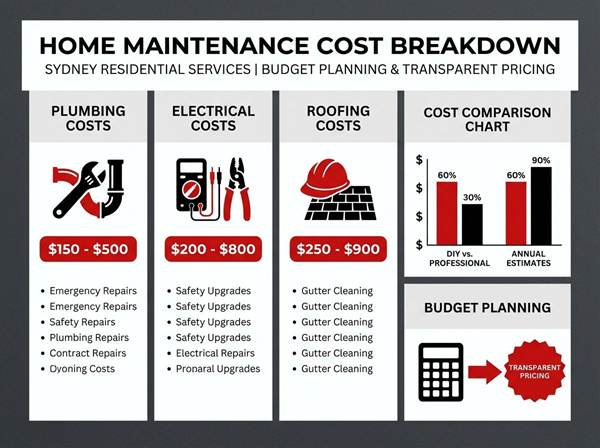
Roofing & Roof Plumbing Costs in Sydney 2026
Your roof protects your entire home, and professional roofing work is essential for preventing water damage. Here are typical costs for roofing services in Sydney.
Roof Repairs & Maintenance
| Service | Typical Cost Range |
| Roof leak repair (minor) | $250 – $600 |
| Tile replacement (per tile) | $50 – $120 |
| Ridge capping repairs | $400 – $900 |
| Flashing repair/replacement | $300 – $800 |
| Valley gutter repair | $350 – $850 |
| Gutter replacement (per meter) | $40 – $80 |
| Complete roof restoration | $4,000 – $12,000 |
| Metal roof replacement (Colorbond) | $15,000 – $35,000 |
| Tile roof replacement | $18,000 – $40,000 |
| Skylight installation | $800 – $2,500 |
Factors That Affect Roofing Costs:
- Roof Pitch & Accessibility: Steep roofs require additional safety equipment and time, increasing costs by 20-40%. Difficult access adds further expenses.
- Roof Size: Pricing often uses per-square-meter rates. A 150-square-meter roof costs significantly more than a 100-square-meter roof for the same work.
- Material Quality: Budget Colorbond costs $60-80/sqm, premium Colorbond costs $100-130/sqm. Concrete tiles are cheaper than terracotta tiles.
- Structural Repairs: If underlying timber or battens are damaged, structural repairs add substantial cost before roofing materials can be installed.
- Heritage or Complex Roofs: Heritage homes with specific tile types, complex multi-level roofs, or unusual designs require specialist tradespeople at premium rates.
- Storm Damage Urgency: Emergency roof repairs after storms command premium pricing due to urgency and high demand during weather events.
Preventive Maintenance
- Professional Roof Inspection: $200-$400 for comprehensive inspection identifying all issues before they become leaks.
- Annual Roof & Gutter Maintenance Package: $300-$600 for complete gutter cleaning, minor repairs, and roof condition check.
- Roof Painting/Restoration: $4,000-$9,000 for complete roof restoration including cleaning, repairs, and protective coating.
- Preventive Maintenance Benefits: Regular roof maintenance (every 1-2 years) extends roof lifespan by 30-50% and prevents emergency repairs costing 3-5x more.
How to Budget for Home Maintenance in Sydney
Understanding individual service costs is valuable, but how much should you actually budget annually for home maintenance? Here’s a practical approach.
The 1% Rule (And Why It Works)
Financial planners recommend budgeting 1-3% of your home’s value annually for maintenance and repairs. For a $900,000 Sydney home, that’s $9,000-$27,000 per year.
This might seem high, but consider:
- $2,000 for annual gutter cleaning, inspections, and minor fixes
- $1,500 for hot water system servicing and eventual replacement fund
- $1,000 for electrical safety checks and minor upgrades
- $2,500 for preventive roofing maintenance
- $2,000 contingency for unexpected repairs
Suddenly $9,000+ seems reasonable—especially when one burst pipe or roof leak can cost $5,000+ to repair properly.
Adjust Based on Home Age:
- New homes (0-10 years): 1% of value
- Mid-age homes (10-25 years): 1.5-2% of value
- Older homes (25+ years): 2-3% of value
Older homes require more frequent repairs and system replacements, justifying higher budget allocation.
Creating Your Annual Maintenance Budget
Essential Annual Services (Plan & Budget These):
- Gutter cleaning: $300-$600 (twice yearly)
- Hot water system service: $150-$250
- Roof inspection: $200-$350 (every 2 years)
- Smoke alarm testing & battery replacement: $0-$150
- Air conditioning service: $150-$300
- Electrical safety check: $200-$400 (every 2-3 years)
Total Predictable Annual Costs: $1,000-$2,050
Emergency Fund: Set aside additional $2,000-$5,000 for unexpected issues like:
- Burst pipes
- Hot water system failure
- Storm roof damage
- Blocked drain emergencies
- Electrical faults
Replacement Fund: Major systems have finite lifespans. Save monthly for eventual replacement:
- Hot water system (10-15 year lifespan): Save $150-$250/year toward $2,500-$3,500 replacement
- Roof (20-40 year lifespan): Save $500-$1,000/year toward $20,000-$40,000 replacement
- Air conditioning (10-15 years): Save $200-$400/year toward $3,000-$6,000 replacement
Preventive vs Emergency Cost Comparison
The most effective way to control maintenance costs is preventing emergencies through regular servicing.
Example: Hot Water Systems
- Annual service cost: $180
- Emergency replacement (failed unexpectedly): $2,500-$3,500 + stress + no hot water for days
- Serviced system lifespan: 12-15 years
- Unserviced system lifespan: 8-10 years
The $180 annual service extends lifespan by 3-5 years (saving $2,500+ replacement) and prevents mid-winter failures.
Example: Roof Maintenance
- Annual gutter cleaning & inspection: $350
- Ignored until leak develops: $600 initial repair + $3,000 internal water damage restoration
- Preventive maintenance ROI: 10:1 or better
Example: Blocked Drains
- Routine drain maintenance: $200-$300 annually
- Emergency blocked drain with sewage overflow: $500-$1,200 emergency call + cleanup costs
Preventive maintenance costs 60-80% less than emergency repairs while avoiding inconvenience and stress.
Red Flags: When Pricing Seems Too Good (or Bad) to Be True
Transparent pricing helps you identify both overpriced quotes and suspiciously cheap offers. Here’s what to watch for.
Warning Signs of Overpricing
- Quotes 50%+ higher than typical ranges without clear justification
- Excessive “diagnostic fees” before providing any actual diagnosis
- Pressure tactics: “price only good if you book today”
- Vague scope descriptions making comparison impossible
- Unwillingness to provide itemized quotes
- No explanation of what’s included vs excluded
What to Do: Get 2-3 competitive quotes for major work. Legitimate price differences should be explainable (better materials, longer warranty, included extras).
Warning Signs of Suspiciously Low Pricing
- Prices 40%+ below typical market rates
- No licensing or insurance mentioned
- “Cash only” with no invoice or receipt
- Avoiding discussing warranties or guarantees
- Unwilling to provide written quotes
- Pressure to pay upfront before work starts
The Risk: Unlicensed work voids insurance, creates safety hazards, may not meet code, and leaves you with no recourse if problems arise. Saving $200 isn’t worth risking a $10,000 insurance claim denial or electrical fire.
NSW Requirements: All plumbers, electricians, and roof plumbers must be licensed. Always verify license numbers with NSW Fair Trading before engaging tradespeople.
Questions to Ask When Comparing Quotes
Before accepting any quote, ask:
1. Is this a fixed price or estimate? (Estimates can change; fixed prices cannot without your approval)
2. What exactly is included? (Labor, materials, removal of old equipment, cleanup, testing?)
3. What is NOT included? (Common exclusions: repairs to damage uncovered during work, upgrades to meet current code)
4. What warranty applies? (Workmanship warranty should be minimum 6-12 months; materials may have manufacturer warranties)
5. Are you licensed and insured? (Get license numbers and verify with NSW Fair Trading)
6. When can you start and complete the work? (Realistic timelines indicate professional workload management)
7. What happens if additional work is needed? (How are variations handled and approved?)
8. Is any follow-up included? (Some companies include post-service checks or adjustments)
Quality professionals answer these questions clearly and provide written confirmation.
Saving Money on Home Maintenance Without Sacrificing Quality
You don’t need to overpay for quality home maintenance. These strategies help you control costs while maintaining high standards.
Timing Your Services Strategically
Book Non-Emergency Work During Off-Peak Times:
- Plumbers are busiest winter (hot water failures) and summer (outdoor plumbing for entertaining)
- Electricians are busy Christmas (lighting) and summer (air conditioning)
- Roofers are busiest immediately after storms
Off-Peak Advantages:
- Better availability = faster service
- More competitive pricing
- Less rush = higher quality attention
- Easier scheduling
Example: Book hot water servicing in October (spring) instead of July (winter) for better availability and potentially better rates.
Bundle Services When Possible
Having one company handle multiple services saves money by:
- Single call-out fee covering multiple jobs
- Efficient scheduling (one visit instead of three)
- Volume discounts for multiple services
- Relationship building for ongoing maintenance
Example: WSG Group offers plumbing, electrical, and roofing services. Having one team perform your annual gutter cleaning, electrical safety check, and roof inspection saves 2 call-out fees ($300-$500) compared to three separate contractors.
Annual Maintenance Plans: Many companies offer bundled annual maintenance packages at discounted rates. These typically include scheduled inspections and priority emergency response.
Invest in Preventive Maintenance
We’ve mentioned this before, but it bears repeating: preventive maintenance is the #1 cost-saver.
ROI Examples:
- $180 annual hot water service → saves $3,000+ premature replacement
- $350 annual gutter cleaning → saves $5,000+ water damage repairs
- $200 electrical safety check → saves $1,500+ fire damage/fault repairs
- $250 roof inspection → saves $8,000+ major leak and ceiling repairs
Every dollar spent on preventive maintenance saves $5-$15 in avoided emergency repairs.
Create a Maintenance Calendar: Schedule inspections and servicing at the same time each year. This prevents forgotten maintenance and catches small issues before they become expensive emergencies.
Know What You Can DIY (and What You Cannot)
Some maintenance tasks are DIY-appropriate:
✓ Testing smoke alarms
✓ Replacing tap washers (cold water taps only)
✓ Changing light bulbs
✓ Cleaning gutter guards (ground level, safe access only)
✓ Resetting tripped circuit breakers
NEVER DIY These Tasks:
✗ Any electrical work beyond changing bulbs (illegal without license)
✗ Gas fitting work (illegal and deadly dangerous)
✗ Work on hot water systems (gas, electric, or heat pump)
✗ Roof work (fall risk + insurance voids if damage occurs)
✗ Drain clearing with chemicals (damages pipes, creates toxic situations)
The Risk: Insurance companies can deny claims for damage caused by unlicensed work. That $150 plumber call you avoided could cost $10,000+ in denied insurance claims.
When in Doubt: If a job involves gas, electrical, heights, or water systems, hire a licensed professional.
Frequently Asked Questions About Home Maintenance Costs
Q: Why do Sydney tradespeople charge more than regional areas?
Sydney trades charge higher rates due to significantly higher business costs: commercial vehicle registrations, parking fees, fuel for extensive travel, commercial rent for workshops, higher insurance premiums, and cost of living allowing them to retain skilled staff. Regional areas have lower overheads. However, Sydney also offers more competition, better availability, and specialized services not available in regional areas.
Q: Should I always choose the cheapest quote?
Not necessarily. The cheapest quote often means: unlicensed work, use of substandard materials, hidden costs revealed later, or rushed work with poor quality. Instead, look for best value: appropriate pricing (within typical ranges), licensed and insured professionals, clear scope, solid warranty, and good reviews. Mid-range quotes from established businesses typically offer the best combination of quality and fair pricing.
Q: Do I need to pay a call-out fee if I don’t proceed with the work?
Yes. The call-out fee covers the professional’s time to travel to your property, assess the situation, and provide a diagnosis and quote. This is fair compensation for their expertise and time even if you choose not to proceed with repairs. Some companies waive call-out fees if you proceed with quoted work above a certain value.
Q: How do I know if a quote is fair?
Compare quotes against the typical ranges in this guide. Get 2-3 quotes for major work. Ask detailed questions about what’s included. Check the tradie is licensed (verify with NSW Fair Trading). Read reviews from previous customers. Be wary of quotes 50%+ higher or 40%+ lower than typical ranges without clear explanation.
Q: Are emergency rates justified?
Yes. Emergency/after-hours rates (typically 50-150% premium) reflect: immediate availability disrupting personal time, stocking vehicles with parts for common emergencies, maintaining 24/7 phone coverage, faster response times, and working evenings/nights/weekends. True emergencies (burst pipes, no power, gas leaks, major roof leaks) justify these rates. Non-urgent issues should wait for standard hours to avoid premiums.
Q: How much should I budget annually for home maintenance?
Budget 1-3% of your home’s value annually: 1% for newer homes (0-10 years), 1.5-2% for mid-age homes (10-25 years), 2-3% for older homes (25+ years). For a $900,000 Sydney home, that’s $9,000-$27,000 per year covering routine servicing, inspections, minor repairs, and building an emergency fund for unexpected issues.
Q: Does WSG Group offer payment plans for major work?
Contact WSG Group directly to discuss payment options for major projects like hot water replacements, switchboard upgrades, or roofing work. Many companies offer payment arrangements for work exceeding $1,000-$2,000 to make necessary repairs manageable.
Q: How can I reduce home maintenance costs without sacrificing quality?
Focus on preventive maintenance (costs 60-80% less than emergency repairs), bundle services with one provider to save call-out fees, schedule non-urgent work during off-peak times for better rates, maintain systems regularly to extend lifespans, and address small issues immediately before they become expensive emergencies.
Making Informed Decisions About Home Maintenance Costs
Understanding typical home maintenance costs in Sydney empowers you to budget confidently, recognize fair pricing, and make informed decisions about your property’s care. While costs can seem significant, remember that professional plumbing, electrical, and roofing services protect your home’s value, ensure family safety, and prevent catastrophic failures that cost exponentially more to remedy.
The key principles for managing maintenance costs effectively:
- Budget Proactively: Set aside 1-3% of your home’s value annually for maintenance. This prevents financial stress when systems inevitably need servicing or replacement.
- Prioritize Prevention: Spending $1,000-$2,000 annually on preventive maintenance saves $5,000-$15,000 in avoided emergency repairs. Regular servicing extends system lifespans and catches small issues before they escalate.
- Choose Quality Over Price: The cheapest quote often becomes the most expensive choice when poor workmanship requires re-doing or causes additional damage. Licensed, insured professionals charging fair market rates provide better long-term value.
- Build Professional Relationships: Working with one trusted company for multiple services saves money through bundled call-out fees, relationship pricing, and priority service during emergencies.
- Address Issues Early: Small leaks, minor electrical faults, and early-stage roof damage are inexpensive to fix. Ignored, they become emergency situations costing 5-10x more.
- Know When to DIY (and When Not To): Save money on appropriate tasks like smoke alarm testing and changing light bulbs, but always hire licensed professionals for electrical work, gas fitting, and roof work. Insurance and safety require it.
At WSG Group, we’ve provided transparent, reliable plumbing, electrical, and roofing services across Sydney and the Central Coast since 1947. Our commitment to upfront pricing, quality workmanship, and long-term customer relationships means you’ll never face surprise costs or hidden fees.
Whether you’re planning your 2026 maintenance budget, getting quotes for current work, or dealing with an unexpected emergency, understanding fair pricing helps you make the right decisions for your home and family.
Ready to discuss your home maintenance needs? Contact WSG Group today for transparent quotes, expert service, and the peace of mind that comes from working with Sydney’s most trusted home service professionals.
Call 1800 186 597 for 24/7 emergency service or to schedule routine maintenance at fair, competitive rates. Let’s keep your home safe, comfortable, and maintained to the highest standards—without unexpected costs or surprises.