

Solar Hot Water or Heat Pump: Which One Works Better for a Sydney Home?
Solar hot water vs heat pump sydney is one of the most common questions we get from NSW homeowners looking to cut energy bills. Both systems replace the traditional electric storage hot water system – still the most widely installed type in Australian homes – with something far more efficient. The right choice for your property depends on your roof orientation, household size, available NSW rebates, and how much you want to spend upfront.
This guide gives you a genuine comparison of both technologies, including real costs, current NSW Government rebate amounts, and which system suits Sydney’s climate and typical household patterns.
- The Australian Baseline: Electric Storage Hot Water
- How Solar Hot Water Works – and What It Costs in Sydney
- How Heat Pump Hot Water Works – and What It Costs in NSW
- Solar vs Heat Pump: Side-by-Side Comparison
- What NSW Government Rebates Are Available?
- Which Is Better for a Sydney Home?
- Frequently Asked Questions
The Australian Baseline: Electric Storage Hot Water
Before comparing the two upgrade paths, it helps to understand what most Australian homes are starting from. The standard electric storage hot water unit – a cylindrical tank, usually 125-400 litres, mounted in a cupboard or externally on the side of the house – is the most common hot water system in Australia. These systems heat water using an electric resistance element and hold it at temperature in the insulated tank.
Electric storage hot water systems are reliable and inexpensive to purchase (typically $400-$900 for the unit), but they are expensive to run. They are one of the largest energy consumers in a typical NSW home, accounting for roughly 20-25% of household energy use. With IPART electricity tariffs in Sydney averaging around 25-35 cents per kWh depending on retailer and tariff, a family of four running a 250-litre electric storage unit can spend $700-$1,200 per year on hot water energy alone.
Both solar hot water and heat pump hot water systems dramatically reduce this running cost, which is why the NSW Government offers rebates to encourage the switch. The question is which technology delivers better value for your specific situation.
How Solar Hot Water Works – and What It Costs in Sydney
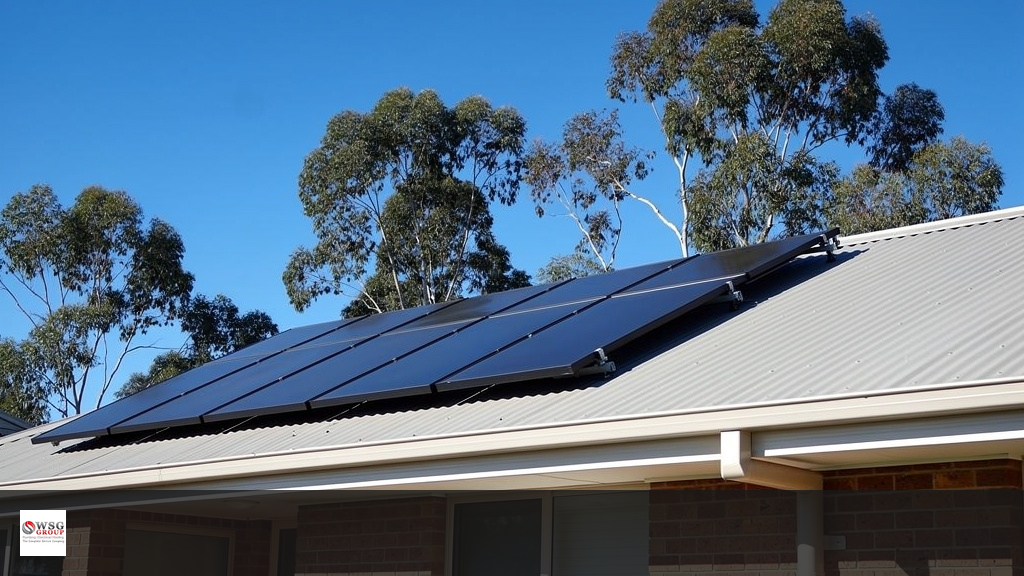
Solar hot water systems use roof-mounted solar collector panels – either flat plate or evacuated tube type – to capture heat from the sun and transfer it to water in a storage tank. Sydney receives an average of 280+ sunny days per year, making it one of the better locations in Australia for solar thermal performance.
The two main types for residential use:
- Flat plate solar collectors – lower upfront cost, good performance in Sydney’s mild to warm climate, less effective in very cold conditions. Most common choice for suburban Sydney homes.
- Evacuated tube collectors – higher efficiency, better cold weather performance (relevant for Blue Mountains properties or homes at elevation), higher upfront cost.
All solar hot water systems include an electric or gas booster element that heats the water when solar input is insufficient – such as in cloudy periods or during peak demand.
Solar Hot Water Costs in Sydney
| Item | Cost (AUD) | Notes |
|---|---|---|
| Flat plate system (supply + install) | $3,000 – $5,000 | Most common for 3-4 bedroom Sydney homes |
| Evacuated tube system (supply + install) | $4,500 – $7,000 | Higher efficiency, better for large households |
| Estimated annual running cost (Sydney) | $150 – $350 | Depends on cloudy periods and booster use |
| Annual savings vs electric storage | $500 – $900 | Family of 4, based on Sydney electricity rates |
| Typical payback period | 5 – 10 years | Varies with usage and tariff structure |
| Expected system lifespan | 15 – 25 years | With regular maintenance (anode replacement every 5 years) |
Roof requirements for solar hot water in Sydney:
- North-facing roof slope is ideal (within 45 degrees of north)
- Panels should be unshaded between 9am and 3pm (minimum)
- Minimum roof pitch of around 15-20 degrees for flat plate collectors; evacuated tubes work at lower pitches
- East or west facing can work with reduced efficiency (roughly 15-20% less output)
- South-facing is generally not viable for solar hot water in NSW
Our hot water system service page covers all types including solar, heat pump, gas, and electric systems for Sydney and the Central Coast.
How Heat Pump Hot Water Works – and What It Costs in NSW
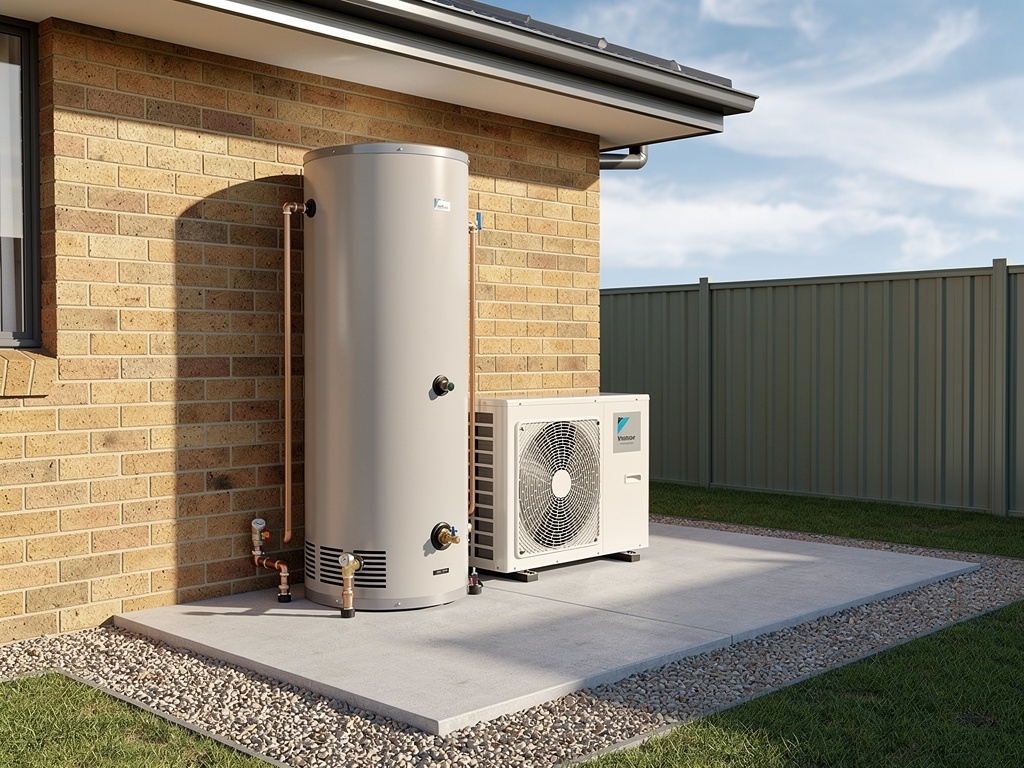
A heat pump hot water system works like a refrigerator in reverse: it extracts heat from the ambient air and uses it to heat water in a storage tank. The compressor unit is typically installed outside the house (on a concrete pad or wall mount), and the storage cylinder sits beside it or connects to an indoor tank. Together they look similar to a standard electric storage system but with a compressor box attached.
Heat pumps are highly efficient because they move heat rather than generate it. For every 1 kWh of electricity consumed, a heat pump produces approximately 3-4 kWh of hot water energy – an efficiency ratio (coefficient of performance, COP) of 3-4. This makes them 3-4 times more efficient than a standard electric resistance element.
Heat pumps operate most efficiently in ambient air temperatures above 5 degrees Celsius. Sydney’s relatively mild winters (rarely below 5 degrees in most suburbs, though the Central Coast and outer western suburbs can be cooler) make heat pumps highly suitable for the region. At temperatures below 5 degrees, performance drops somewhat, but this is rarely a problem in coastal Sydney.
Heat Pump Hot Water Costs in NSW
| Item | Cost (AUD) | Notes |
|---|---|---|
| Heat pump system 200-250L (supply + install) | $2,500 – $4,000 | After Small-scale Technology Certificate (STC) rebate |
| Heat pump system 300-315L (supply + install) | $3,200 – $5,500 | Larger household or high hot water demand |
| NSW Government PDRS rebate (heat pump) | $500 – $1,200+ | Peak Demand Reduction Scheme; amount varies by product and zone |
| Estimated annual running cost (Sydney) | $200 – $450 | Using off-peak electricity; significantly less than electric storage |
| Annual savings vs electric storage | $400 – $800 | Family of 4, Sydney electricity tariffs |
| Expected system lifespan | 10 – 15 years | Compressor life; tank may last longer |
| Operating temperature range (optimal) | 5°C to 35°C ambient | Performance reduces below 5°C; Sydney rarely reaches this |
For more detail on running costs and rebates, see our article on hot water system replacement costs in Sydney.
Solar vs Heat Pump: Side-by-Side Comparison
| Factor | Solar Hot Water | Heat Pump Hot Water |
|---|---|---|
| Upfront cost | $3,000 – $7,000 | $2,500 – $5,500 (after STCs) |
| NSW rebates available | Small-scale Technology Certificates (STCs) | STCs + NSW PDRS rebate ($500-$1,200+) |
| Annual running cost | $150 – $350 | $200 – $450 |
| Efficiency | High (solar energy = free); COP equivalent 3-6 | High; COP 3-4 (3-4x more efficient than element) |
| Roof requirement | North-facing roof, unshaded, min 15° pitch | None – needs 1m2 of outdoor space for compressor |
| Cold weather performance | Reduced on overcast days (booster cuts in) | Reduced below 5°C (rarely an issue in Sydney) |
| System lifespan | 15 – 25 years | 10 – 15 years |
| Noise | Silent | Compressor noise (50-60 dB) – consider placement |
| Best suited for | Homes with north-facing roof, larger households, high hot water use | Homes without ideal solar orientation, smaller blocks, rental properties |
| Maintenance | Anode replacement every 5 years; occasional panel flush | Anode replacement every 5 years; filter clean annually |
What NSW Government Rebates Are Available?
NSW currently offers rebates and incentive schemes for both solar hot water and heat pump hot water systems through two main mechanisms:
1. Small-scale Technology Certificates (STCs)
STCs are a federal scheme administered through the Clean Energy Regulator. Both solar hot water and heat pump systems are eligible. The number of STCs your system generates depends on its rated output and your climate zone (Sydney is Zone 3). In 2025-2026, a typical heat pump system for a Sydney home generates 20-35 STCs, worth approximately $600-$1,000 at current STC prices. Your installer typically assigns the STCs to the retailer in exchange for a point-of-sale discount – you do not have to manage the certificates yourself.
2. NSW PDRS – Peak Demand Reduction Scheme
The NSW Government’s Peak Demand Reduction Scheme (PDRS) provides financial incentives specifically for heat pump hot water systems. Under the PDRS, upgrading from a conventional electric storage system to a heat pump earns Peak Reduction Certificates (PRCs). These are typically assigned to your installer and passed on as a discount or rebate at the time of purchase.
For 2025-2026, eligible heat pump hot water upgrades in the Sydney and Central Coast region can attract PDRS incentives worth $500 to over $1,200 depending on the system capacity and the current certificate price. You can check the current PDRS calculator at energy.nsw.gov.au/households/grants-rebates.
3. Low Income Household Rebate (NSW)
NSW concession card holders may be eligible for the Low Income Household Rebate, which provides a reduction on electricity bills year-round. This is not specific to hot water but makes the running cost comparison more favourable for eligible households.
Which Is Better for a Sydney Home?
For most Sydney homeowners in 2026, a heat pump hot water system is the more practical choice – particularly when considering the larger NSW PDRS rebate, the absence of a roof orientation requirement, and the significant improvement in heat pump technology reliability and noise levels in recent years.
That said, solar hot water wins in several specific scenarios:
- You have an ideal north-facing, unshaded roof and want the longest possible lifespan (25 years vs 15 for a heat pump)
- You have a large household (5+ people) with consistently high hot water demand – solar panels scale well with large tanks
- You are in a bushfire-prone area where the outdoor compressor unit of a heat pump may be exposed to debris or embers
- Noise is a priority – solar hot water is completely silent; a heat pump compressor produces 50-60 dB during operation
Heat pump hot water is the better choice when:
- Your roof does not face north, or is partially shaded by trees, neighbouring structures, or a second storey addition
- You want to take advantage of the larger NSW PDRS rebate currently available for heat pumps
- You have a smaller block where roof panel installation would be complex
- You are a landlord replacing a system in a rental property and want the lower upfront cost
Both systems deliver genuine, measurable savings compared to a standard electric storage unit. On IPART-regulated tariffs in Sydney, most households will recover the cost of a heat pump system within 5-8 years and the cost of a solar system within 6-10 years, depending on household size and usage patterns.
For help choosing the right system for your Central Coast or Sydney home, speak to the WSG Group hot water team – we install and service both technologies across the region. See our full hot water system services page for available brands and options.
Ready to Cut Your Hot Water Bills?
WSG Group installs solar and heat pump hot water systems across Sydney and the Central Coast. We handle all NSW PDRS and STC paperwork so you get the maximum rebate with no hassle. Call 1800 186 597 or request a quote online.
Frequently Asked Questions: Solar Hot Water vs Heat Pump in Sydney
Is a heat pump hot water system worth it in Sydney?
Yes, for most Sydney homes a heat pump hot water system is worth it. Sydney’s mild climate means the system runs at high efficiency year-round. With current NSW PDRS and STC rebates reducing the upfront cost by $1,000-$2,000+, and annual savings of $400-$800 compared to electric storage, most households reach payback within 5-8 years.
Can I get a government rebate for solar hot water in NSW?
Yes. Solar hot water systems are eligible for federal Small-scale Technology Certificates (STCs), worth approximately $600-$900 for a typical Sydney installation depending on system size and STC prices at the time of installation. The NSW PDRS rebate applies specifically to heat pumps, not to solar thermal systems.
How much water does a heat pump hot water system need?
A heat pump hot water system stores water in a conventional tank – typically 200-315 litres for a residential installation. It does not consume extra water compared to a standard electric storage system. The compressor draws heat from the air, not from a water source, so there is no additional water usage beyond normal hot water consumption.
Does a heat pump hot water system work on cold Sydney winter nights?
Yes. Most residential heat pumps are rated to operate down to 5 degrees Celsius ambient air temperature. Sydney’s minimum overnight temperatures rarely drop below 8-10 degrees in most suburbs (June-August average lows are 9-12 degrees), so heat pumps function efficiently through Sydney winters. Properties at higher elevations or on the Central Coast’s western fringes may see slightly lower efficiency on very cold nights, but the system will always produce hot water – it just uses a backup element if needed.
Can a heat pump hot water system be installed in a unit or apartment?
Generally no – a heat pump requires outdoor space for the compressor unit (typically at least 1 square metre of well-ventilated external area) and produces compressor noise during operation. This makes it unsuitable for most apartments or townhouses without a private outdoor area. Solar hot water also typically requires roof access. For apartments, instantaneous gas systems or dedicated solar PV diversion controllers are more practical alternatives.
What is the NSW PDRS rebate for heat pump hot water?
The NSW Peak Demand Reduction Scheme (PDRS) provides financial incentives for upgrading from electric storage hot water to a heat pump system. In 2025-2026, eligible installations in the Sydney and Central Coast region attract rebates worth approximately $500-$1,200+ depending on system capacity and current certificate prices. Your installer manages the PDRS paperwork and applies the discount at the point of sale.