

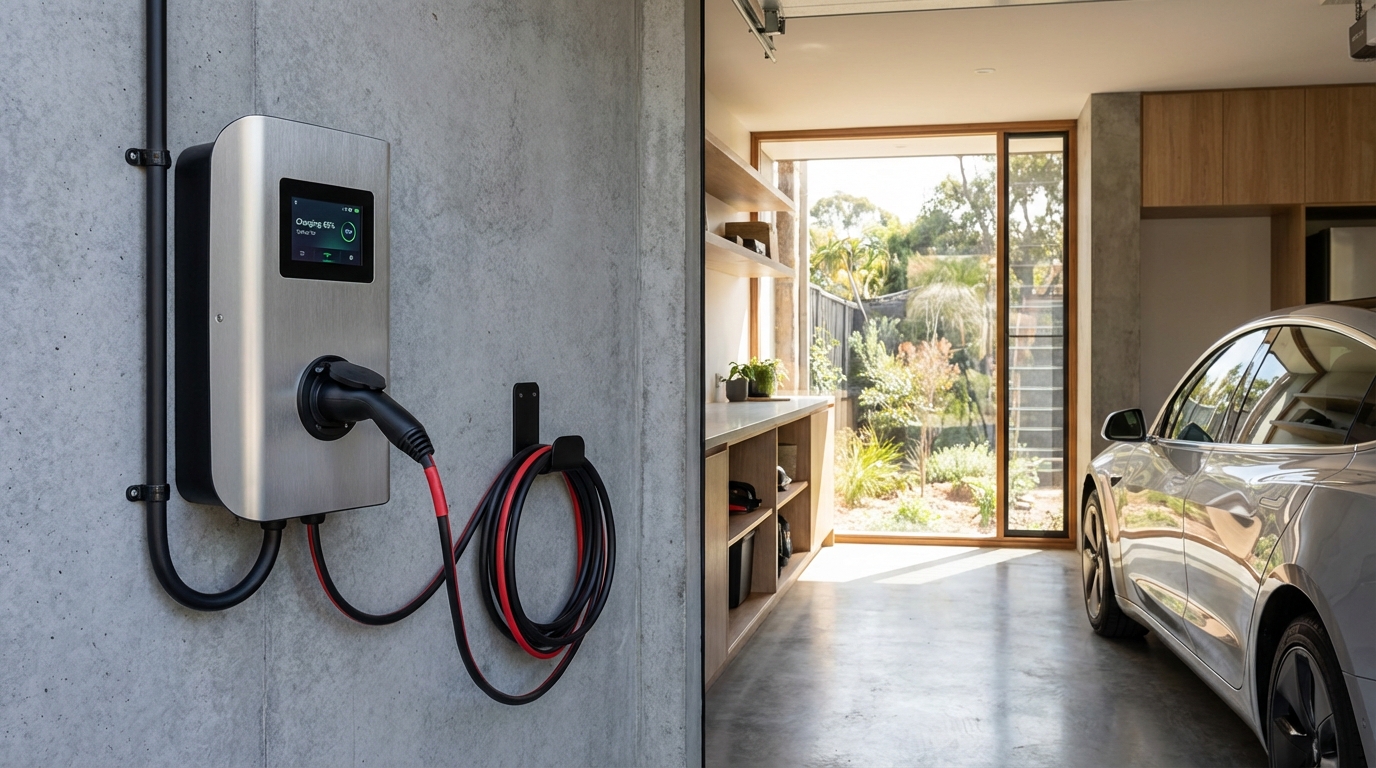
Electric vehicle adoption in Australia has reached a tipping point. With EV sales capturing 12.2% of the Australian new car market in February 2026—a remarkable 51% increase year-over-year—more Sydney homeowners are asking the critical question: how do I set up reliable, cost-effective home charging?
Whether you’ve just purchased your first Tesla, BYD, or Polestar, or you’re planning ahead for an EV purchase before the end of financial year (EOFY), understanding EV charger installation Sydney requirements is essential. Home charging isn’t just convenient—it’s the foundation of EV ownership, potentially saving you thousands annually compared to public charging networks.
This comprehensive guide breaks down everything Sydney homeowners need to know about EV charger installation: real costs for 2026, electrical requirements for your home, choosing between Level 1 and Level 2 charging, navigating switchboard upgrades, EOFY tax considerations, and how to future-proof your electrical system. As licensed electricians servicing Sydney and the Central Coast since 1947, WSG Group provides expert guidance to ensure your home EV charging installation is safe, efficient, and compliant.
Why Install a Home EV Charger in 2026?
The shift from petrol to electric isn’t just about environmental consciousness—it’s about practical economics and lifestyle convenience. Here’s why Sydney homeowners are prioritising EV charger installation in 2026:
- Cost Savings: Charging at home costs approximately $0.25-0.35 per kWh (depending on your electricity plan and time-of-use rates), compared to $0.40-0.70 per kWh at public fast charging stations. For an average driver covering 15,000km annually, home charging can save $800-1,200 per year.
- Convenience: Wake up every morning with a fully charged vehicle—no more trips to petrol stations or waiting at public chargers. For most Sydney households, overnight charging provides 100% state-of-charge by morning.
- Property Value: Homes with installed EV charging infrastructure are increasingly attractive to buyers. As EV adoption accelerates, home charging capability is becoming a standard expectation, similar to garages and carports in previous decades.
- EOFY Planning Opportunity: For investment property owners, rental properties, or home-based businesses, EV charger installation completed before June 30, 2026, may qualify for legitimate tax deductions. Strategic timing matters for maximizing financial benefits.
- Energy Independence: Pairing your EV charger with solar panels creates genuine energy independence—charging your vehicle with clean, self-generated electricity and minimizing reliance on the grid.
Understanding EV Charging Levels: Level 1 vs Level 2
Before diving into installation requirements and costs, it’s essential to understand the two primary home charging options available to Sydney homeowners.
Level 1 Charging (Standard Power Point)
Level 1 charging uses your home’s standard 240V 10-amp power outlet—the same outlet you’d use for a kettle or phone charger. Most EVs come with a portable Level 1 charging cable (often called a “granny charger” in Australia).
- Charging Speed: 10-15 km of range per hour
- Full Charge Time: 24-40 hours for a typical EV (60-75 kWh battery)
- Power Draw: 2.3-2.4 kW
- Installation Cost: $0 (uses existing outlet)
- Best For: Plug-in hybrids (PHEVs), low-mileage drivers, backup charging
Level 1 charging is the slowest method, but it’s adequate if you drive less than 50km daily and can leave your vehicle plugged in overnight. However, most Sydney EV owners quickly discover Level 1 charging is insufficient for regular use.
Level 2 Charging (Dedicated Wall Charger)
Level 2 charging requires a dedicated 240V high-power circuit, typically 15-32 amps, powering a purpose-built wall-mounted EV charging station.
- Charging Speed: 30-60 km of range per hour (single-phase), 60-150 km/hour (three-phase)
- Full Charge Time: 4-8 hours for a typical EV (60-75 kWh battery)
- Power Draw: 7.2-22 kW (depending on single or three-phase installation)
- Installation Cost: $1,200-3,300 (including charger and installation)
- Best For: Daily EV drivers, households with multiple EVs, future-proofing
Level 2 charging is the gold standard for home EV charging. It provides practical, overnight charging speeds that align with typical Australian driving patterns (40-50km daily average).
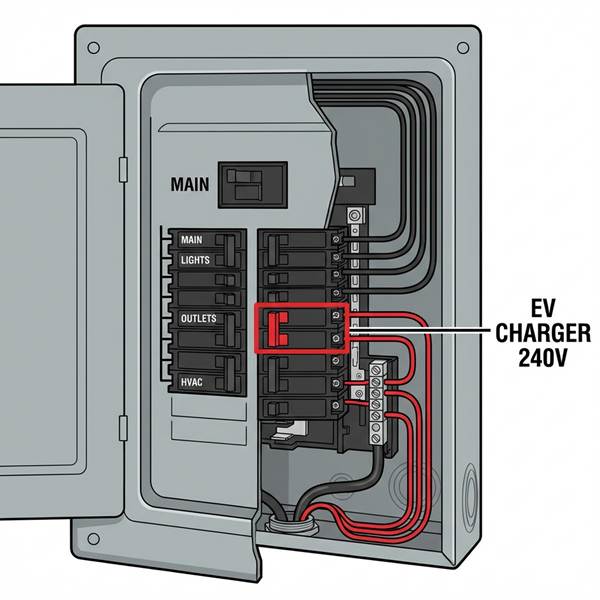
Electrical switchboard with dedicated EV charging circuit
Electrical Requirements for Home EV Charger Installation
Installing a Level 2 EV charger isn’t as simple as mounting a box on your garage wall—it requires careful assessment of your home’s electrical infrastructure.
Switchboard Capacity Assessment
Your home’s switchboard (main electrical panel) must have sufficient capacity to support an additional high-power circuit. Most modern Sydney homes have 63-80 amp main breakers, while older homes may have 40-50 amp capacity.
A Level 2 EV charger typically requires a dedicated 20-40 amp circuit. If your existing switchboard is near capacity, you may need:
- Switchboard upgrade: $800-2,500
- Sub-board installation: $600-1,200
- Load management system: $400-900
A qualified electrician will conduct a load calculation to determine whether your current switchboard can accommodate the additional EV charging load without compromising safety or tripping breakers.
Dedicated Circuit Requirements
EV chargers must have a dedicated circuit—meaning no other appliances or outlets share the same circuit breaker. This prevents overload and ensures consistent, safe charging.
Circuit specifications:
- Cable size: 6mm² or 10mm² depending on distance and amperage
- Circuit breaker: 20A, 25A, 32A, or 40A (matched to charger specifications)
- Circuit protection: RCD (Residual Current Device) required
- Cable run distance: Maximum 30-40 metres from switchboard
Single-Phase vs Three-Phase Power
Most Sydney residential properties have single-phase power (230V), which supports EV chargers up to 7.2 kW (32A). This provides 30-40 km of range per hour—sufficient for most households.
Three-phase power (400V) is less common in residential properties but offers faster charging speeds (up to 22 kW) and better future-proofing. Three-phase installations are typical in commercial properties, newer developments, and homes with high electrical demands (pools, workshops, etc.).
Upgrading from single to three-phase power costs $3,000-8,000 depending on distance from the street transformer and Ausgrid/Endeavour Energy connection requirements.
Garage and Carport Considerations
Your EV charger installation location matters. Key considerations include:
- Distance from switchboard (longer cable runs increase cost)
- Weatherproofing requirements (outdoor installations need IP65-rated chargers)
- Parking configuration (fixed wall-mount vs retractable cable)
- Vehicle access (avoid obstacles, maintain clearances)
- Future-proofing (consider second EV or visitor charging)
Complete Cost Breakdown for EV Charger Installation Sydney
Understanding the true cost of EV charger installation helps Sydney homeowners budget accurately and avoid surprises. Here’s a detailed breakdown based on February 2026 NSW pricing data.
EV Charger Hardware Costs
- Budget/Basic Chargers ($500-1,000): Simple, non-networked chargers with basic functionality. Suitable for straightforward installations with minimal requirements.
- Mid-Range Chargers ($1,000-1,800): Smart chargers with WiFi connectivity, smartphone apps, energy monitoring, and scheduling features. Popular brands include Zappi, EVSE, Wallbox.
- Premium Chargers ($1,800-2,500): Advanced chargers with load management, solar integration, multiple vehicle management, OCPP compatibility. Ideal for future-proofing or multi-EV households.
Installation Labour Costs
- Standard Installation ($700-1,200): Charger located within 10 metres of switchboard, existing switchboard has capacity, no obstacles.
- Complex Installation ($1,200-2,000): Longer cable runs (10-30 metres), minor switchboard modifications, outdoor weatherproofing requirements.
- Switchboard Upgrade Required ($1,800-3,300): Full switchboard replacement or major upgrade needed to accommodate EV charging circuit.
Average Total Cost (Sydney, February 2026)
According to Solar Choice’s EV Charger Price Index, the average EV charger installation cost in NSW is $2,309 (including GST) for a complete turnkey installation.
Cost Range by Scenario:
- Simple installation, budget charger: $1,200-1,800
- Standard installation, mid-range charger: $1,800-2,500
- Complex installation, premium charger: $2,500-3,300
- Installation + switchboard upgrade: $3,000-4,500
Additional Costs to Consider
- Electrical Certificate of Compliance: Included in licensed electrician quote
- Council permits (if required): $100-300
- Strata approval (for apartments/townhouses): Variable
- Trenching for underground cabling: $50-120 per metre
- Concrete pad or mounting board: $200-500
Cost Comparison: DIY vs Professional Installation
While some overseas jurisdictions permit DIY EV charger installation, Australian electrical regulations require all fixed electrical installations to be completed by licensed electricians. Attempting DIY installation is illegal, dangerous, and voids insurance coverage.
Professional installation ensures:
- Compliance with AS/NZS 3000 (Wiring Rules)
- Proper earthing and circuit protection
- Electrical safety certificate
- Insurance validity
- Manufacturer warranty protection
Step-by-Step EV Charger Installation Process
Understanding what to expect during your EV charger installation helps Sydney homeowners prepare and ensures a smooth process.
Step 1: Initial Consultation and Site Assessment (Week 1)
A qualified electrician visits your property to:
- Assess switchboard capacity and condition
- Measure cable run distance to proposed charger location
- Identify any obstacles or complications
- Discuss your EV model and charging requirements
- Recommend appropriate charger options
- Provide detailed written quote
This consultation should be free or low-cost ($50-100 if charged).
Step 2: Charger Selection and Order (Week 1-2)
Based on the site assessment, you’ll select:
- Charger brand and model
- Charging speed (7.2kW vs 22kW)
- Features (smart connectivity, solar integration, etc.)
- Cable length (typically 5-7 metres)
- Mounting location
Your electrician orders the charger (1-5 days delivery for local stock, 2-3 weeks for imports).
Step 3: Electrical Work and Installation (Day of Installation)
Professional installation typically takes 3-6 hours and includes:
- Installing dedicated circuit breaker in switchboard
- Running cable from switchboard to charger location
- Installing mounting board or pad (if required)
- Mounting EV charger securely to wall
- Connecting charger to dedicated circuit
- Installing RCD protection
- Testing all safety systems
- Commissioning and demonstration
Step 4: Compliance and Certification (Same Day)
Upon completion, your electrician provides:
- Certificate of Electrical Safety (NSW mandatory)
- Manufacturer warranty documentation
- User manual and charging instructions
- Smartphone app setup (for smart chargers)
Step 5: Council Notification (If Required)
Most EV charger installations are classified as “minor electrical work” and don’t require council approval. However, if structural changes are needed (cutting brick walls, major trenching, etc.), your electrician will handle council notifications.
Timeline Summary
- Consultation to quote: 1-3 days
- Charger ordering: 1-14 days
- Installation day: 3-6 hours
- Total project timeline: 1-3 weeks
Choosing the Right EV Charger for Your Sydney Home
With dozens of EV charger models available in Australia, selecting the right one requires balancing features, budget, and future requirements.
Key Features to Consider
- Smart Connectivity: WiFi-enabled chargers allow remote monitoring, scheduling, and energy tracking via smartphone apps. Schedule charging during off-peak electricity rates (typically 10pm-7am in Sydney) to maximise savings.
- Solar Integration: If you have or plan to install solar panels, choose a charger with solar diversion capability. This prioritises solar energy for EV charging before drawing from the grid.
- Load Management: Advanced chargers can communicate with your home energy system to balance EV charging with other household loads, preventing circuit overload.
- OCPP Compatibility: Open Charge Point Protocol (OCPP) ensures your charger works with future energy management systems and isn’t locked to a single manufacturer’s ecosystem.
- Cable Length: Standard is 5 metres, but 7-metre cables provide greater flexibility for different parking positions and future vehicle changes.
- Weatherproofing: For outdoor installations, ensure IP65 or higher weatherproof rating to withstand Sydney’s climate.
- Popular EV Charger Brands in Australia (2026)
- Zappi: UK-designed, highly popular in Australia. Excellent solar integration, 7.2kW single-phase or 22kW three-phase. $1,400-1,900.
- EVSE: Australian-made chargers with local support. Good value, reliable performance. 7.2kW models from $900-1,400.
- Wallbox Pulsar Plus: Spanish brand with sleek design and robust app. 7.4kW, smart features. $1,200-1,600.
- Tesla Wall Connector: Designed for Tesla vehicles but works with all EVs (with adapter). 11kW max. $750-950.
- ABB Terra AC: Commercial-grade reliability for residential use. Three-phase capable, OCPP compliant. $1,600-2,200.
- Schneider EVlink: Enterprise-quality for home use. Excellent build quality, long warranty. $1,500-2,000.
Tethered vs Untethered (Socket) Chargers
- Tethered chargers have permanently attached cables—convenient and weather-resistant, but less flexible if you change EV models or need different cable types.
- Untethered (socket) chargers use removable cables—greater flexibility and cheaper cable replacement, but cables can be stolen or damaged.
EOFY Tax Considerations for EV Charger Installation
As we approach the end of financial year (June 30, 2026), Sydney property owners should understand potential tax implications of EV charger installation.
Tax Deductions for Rental Property Owners
If you own investment properties in Sydney or the Central Coast, EV charger installation may qualify as a legitimate tax deduction under ATO guidelines.
- Capital Works Deduction: EV charger installation permanently attached to the property structure may qualify as capital works, allowing depreciation deductions over time.
- Repairs and Maintenance: Electrical upgrades required for EV charger installation (switchboard work, circuit installation) may qualify as immediate deductions if they maintain the property’s income-producing capacity.
- Property Improvement: Adding EV charging infrastructure increases property appeal to tenants, potentially justifying higher rental income and improving tax position.
Tax Deductions for Home-Based Businesses
If you operate a business from your Sydney home and use your EV for business purposes, you may claim proportional deductions for:
- EV charger hardware (depreciation)
- Installation costs (capital works)
- Electricity costs (operating expenses)
The deductible percentage is based on business use ratio. For example, if your EV is 60% business use, you may claim 60% of charging costs.
No Residential Rebates in NSW (2026 Reality Check)
Unlike ACT, Victoria, and South Australia, NSW currently offers no residential rebates or incentives for home EV charger installation. The NSW EV Fleets Incentive applies only to businesses purchasing multiple EVs.
While disappointing, understanding this reality helps Sydney homeowners budget accurately without relying on rebates that don’t exist.
EOFY Planning Strategy
For property owners considering EV charger installation:
- Consult your accountant before June 30, 2026
- Obtain detailed tax invoices showing equipment and labour separately
- Document business/investment use percentage
- Keep all compliance certificates and quotes
- Consider timing installation to maximize deduction timing
Future-Proofing Your Home Electrical System for EV Charging
Smart EV charger installation in 2026 means anticipating future requirements, not just solving today’s needs.
Planning for Multiple EVs
Australian households are projected to average 1.8 EVs per home by 2035. Consider:
- Installing conduit for a second charger location
- Selecting chargers with load-balancing capabilities
- Ensuring switchboard capacity for dual charging
- Designing parking layout for two charging points
The marginal cost of pre-wiring for a second charger during initial installation ($200-400) is far less than retrofitting later ($1,000-1,500).
Solar and Battery Integration
Solar panel adoption continues accelerating across Sydney. Future-proof your EV charging by:
- Selecting solar-compatible chargers
- Ensuring inverter capacity for simultaneous solar generation and EV charging
- Planning battery storage integration
- Installing smart energy management systems
Charging your EV with self-generated solar power achieves the ultimate cost efficiency—essentially free transport after system payback (typically 6-8 years).
Vehicle-to-Home (V2H) and Vehicle-to-Grid (V2G)
Next-generation EVs will support bidirectional charging—using your EV battery to power your home during outages or sell electricity back to the grid during peak periods.
To prepare for V2H/V2G:
- Select chargers with bidirectional capability (currently limited but expanding)
- Ensure switchboard supports backfeed
- Consider three-phase power for greater flexibility
Increasing Power Requirements
Future EVs will feature larger batteries (100+ kWh) and faster onboard chargers (11-22 kW standard). Installing 32A circuits today (even if your current EV only uses 16A) provides headroom for future vehicles without costly upgrades.
Common EV Charger Installation Challenges and Solutions
Real-world EV charger installations in Sydney often encounter obstacles. Here’s how to navigate them.
Challenge 1: Insufficient Switchboard Capacity
Older Sydney homes (pre-1990s) often have 40-50 amp main breakers insufficient for EV charging plus existing loads.
Solution: Switchboard upgrade to 63-80 amp capacity ($1,200-2,500) or installation of smart load management system that automatically reduces EV charging power when other high-load appliances (air conditioning, pool pumps) operate.
Challenge 2: Long Cable Run Distance
If your parking area is far from the switchboard (common in large blocks or properties with rear garages), cable costs and voltage drop become issues.
Solution: Install a sub-board closer to the charging location, use larger cable gauge (10mm² instead of 6mm²), or relocate parking closer to electrical infrastructure.
Challenge 3: Strata Approval (Apartments/Townhouses)
Installing EV chargers in strata-titled properties requires body corporate approval, which can be slow or contentious.
Solution: Present a detailed installation plan showing no impact on common property, offer to cover costs entirely, demonstrate compliance with NSW strata laws supporting EV charging infrastructure.
Challenge 4: Underground Power Connection
Properties with underground power supplies may require trenching from the street to your meter box for upgrades.
Solution: Engage your distribution network operator (Ausgrid or Endeavour Energy) early, budget $2,000-5,000 for network connection upgrades if required.
Challenge 5: Bushfire-Prone Areas
Properties in bushfire-prone areas have additional electrical installation requirements.
Solution: Select bushfire-compliant switchboards and cabling, engage electricians experienced with AS 3959 bushfire construction requirements, expect 10-15% cost premium.
Frequently Asked Questions About EV Charger Installation Sydney
Do I need a permit to install an EV charger in Sydney?
Most EV charger installations are classified as minor electrical work and don’t require council permits. However, all electrical work must be completed by licensed electricians and comply with AS/NZS 3000 standards. Your electrician will provide a Certificate of Electrical Safety upon completion. If structural modifications are needed (cutting brick walls, major trenching), council notification may be required.
Can I install an EV charger if I rent my Sydney home?
Technically yes, but you’ll need written permission from your landlord. Most landlords are receptive if you offer to cover installation costs and the charger adds value to the property. Consider portable EV chargers that plug into standard outlets (Level 1 charging) if permanent installation isn’t possible. NSW residential tenancy laws don’t specifically address EV charging, so negotiation is required.
How long does EV charger installation take?
A standard installation typically takes 3-6 hours of on-site work. However, the total project timeline from initial consultation to completion is usually 1-3 weeks, accounting for site assessment, charger ordering, and scheduling. Complex installations requiring switchboard upgrades may take 6-8 hours. Emergency or priority installations can sometimes be completed within 48 hours.
Will an EV charger increase my electricity bill significantly?
Yes, but it’s still far cheaper than petrol. Charging a typical EV (60 kWh battery) costs $15-21 at standard residential electricity rates ($0.25-0.35/kWh). For 15,000km annual driving, expect $600-900 in electricity costs compared to $2,400-3,200 in petrol costs for an equivalent combustion vehicle. Using off-peak rates (often $0.15-0.20/kWh) reduces costs further to $400-600 annually.
Can I charge my EV from solar panels?
Absolutely. Pairing solar panels with EV charging is the most cost-effective approach. A 6.6 kW solar system (typical Sydney residential size) generates approximately 25-30 kWh daily—enough to fully charge most EVs. Select a solar-compatible smart charger that prioritises solar energy before drawing from the grid. This effectively provides free EV charging after solar system payback (6-8 years).
Do I need three-phase power for home EV charging?
No. Single-phase power (standard in most Sydney homes) supports 7.2 kW charging, providing 30-40 km of range per hour—adequate for typical overnight charging. Three-phase power enables faster charging (up to 22 kW) but is unnecessary for most households and costs $3,000-8,000 to install if not already present. Consider three-phase only if you drive exceptionally high daily distances (200+ km) or own multiple EVs.
What’s the best EV charger brand for Sydney homes?
Popular, reliable brands include Zappi (excellent solar integration), EVSE (Australian-made, local support), Wallbox Pulsar Plus (smart features, sleek design), and Tesla Wall Connector (good value, works with all EVs). The ‘best’ charger depends on your specific requirements: solar integration, smart features, budget, and future-proofing needs. WSG Group electricians can recommend options based on your situation.
Can WSG Group install EV chargers in Sydney and Central Coast?
Yes. WSG Group’s licensed electricians provide complete EV charger installation services across Sydney and the Central Coast. We handle site assessment, switchboard evaluation, charger recommendation, professional installation, and compliance certification. Contact us for a free on-site assessment and transparent quote with no hidden costs. Our team is available 24/7 for emergency electrical services.
Making the Smart Choice for Home EV Charging
Installing an EV charger in your Sydney home represents more than just convenient vehicle charging—it’s an investment in sustainable transport, energy independence, and future-proofed property value. With EV adoption accelerating rapidly across Australia and petrol prices remaining volatile, home charging infrastructure is becoming as essential as driveways and garages.
The key to successful EV charger installation is working with experienced, licensed electricians who understand both the technical requirements and the unique characteristics of Sydney’s residential electrical infrastructure. From switchboard capacity assessments to solar integration planning, professional guidance ensures your installation is safe, compliant, efficient, and future-ready.
At WSG Group, we’ve been providing trusted electrical services to Sydney and Central Coast homes since 1947. Our team of licensed electricians brings decades of experience to every EV charger installation, ensuring your project is completed professionally, transparently, and with guaranteed workmanship.
Whether you’re planning your EV charger installation for EOFY timing, preparing for a new vehicle delivery, or future-proofing your property, WSG Group is here to help.
📞 Ready to Install Your Home EV Charger?
Contact WSG Group today for a FREE on-site assessment and transparent quote. Our licensed electricians service Sydney and the Central Coast with 24/7 availability for all your electrical needs.
☎️ Call Now: 1800 186 597
📧 Email: info@wsggroup.com.au